WHO BUILT THIS?” Archaeological Whispers Erupt After Strange Signals Reveal Possible Secret Space Beneath the Great Pyramid of Giza—And the Implications Are Stirring Global Controversy
For more than 4,500 years the colossal stones of the Great Pyramid have quietly watched humanity argue about them.
Tourists stare up at it.
Historians write books about it.
Documentary narrators whisper dramatic lines like, “But what if everything we know… is wrong?”
And now the internet has discovered its newest obsession: a mysterious hidden space reportedly detected beneath the legendary pyramid.
The moment the phrase “hidden room” appeared next to the words “Great Pyramid,” the online world did exactly what it always does when ancient monuments are involved.
It completely lost its mind.
Within hours, dramatic headlines began spreading across social media claiming that a secret chamber had been discovered beneath the Great Pyramid of Giza — and, according to some especially enthusiastic commentators, the structure might not have been built by the Ancient Egyptians at all.

Yes.
You read that correctly.
Apparently the internet has once again entered the phase where every ancient stone block becomes evidence of a lost civilization, secret technology, or visitors from somewhere extremely far away.
Cue the YouTube thumbnails.
Within hours of the story appearing online, videos popped up with titles like “THEY HID THIS FROM US,” “THE PYRAMID SECRET FINALLY REVEALED,” and the always reliable classic: “THIS CHANGES EVERYTHING.”
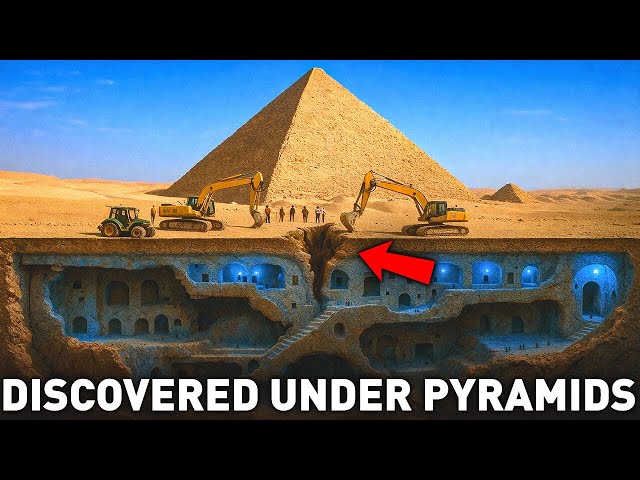
One thumbnail showed the pyramid glowing like a UFO landing site.
Another displayed a mysterious tunnel illuminated by blue lightning.
A third included a giant red arrow pointing at what appeared to be… sand.
The internet, clearly, was ready for drama.
But let’s rewind for a moment and look at the actual scientific background behind the excitement.
Researchers studying the Great Pyramid have spent decades using advanced scanning technologies to explore its internal structure.
One of the most fascinating methods is called muon tomography — a technique that uses cosmic particles constantly passing through the Earth to detect hidden voids inside massive structures.
Think of it like an X-ray for pyramids.
Scientists place detectors around the structure and measure how many particles pass through different sections of stone.
If there is an empty space behind the rock, more particles pass through.
If there is solid stone, fewer make it through.
In other words, the universe itself becomes a giant scanning machine.
And thanks to that technology, researchers have already discovered previously unknown cavities inside the pyramid, including the now-famous “Big Void” detected several years ago.

So when rumors started spreading about another possible hidden chamber beneath the structure, curiosity exploded instantly.
But the leap from “possible hidden space” to “definitely not built by Egyptians” happened faster than a tourist climbing the pyramid stairs before the guards shout at them.
Social media speculation took the story and ran straight into conspiracy territory at Olympic speed.
Some posts claimed the chamber might contain lost technology.
Others suggested it could be part of an ancient underground complex.
And yes, inevitably, several theories involved mysterious advanced civilizations that supposedly existed before recorded history.
One particularly dramatic post declared that the chamber might hold “evidence of an unknown civilization with engineering knowledge far beyond ancient Egypt.”
Which sounds extremely impressive.
It also sounds suspiciously like the plot of about 37 different history-channel documentaries.
Meanwhile, actual archaeologists responded with the emotional enthusiasm of people who have seen this movie many times before.
Dr.Elena Carter, an Egyptologist who studies ancient architecture, reportedly sighed during an interview when asked about the viral theories.
“Every time a new space is detected in the pyramid,” she explained calmly, “the internet immediately assumes aliens or lost civilizations.”
Her tone suggested this was not her first time explaining the difference between archaeology and science fiction.
Because here’s the key detail that tends to get lost in viral headlines: discovering a void inside the pyramid does not automatically mean someone mysterious built it.
The Great Pyramid is an enormous structure with millions of stone blocks and complex internal passages.
It was built around 2560 BCE during the reign of Pharaoh Khufu.
Engineers and workers created chambers, corridors, and structural spaces as part of the construction process.
Some spaces may have had ceremonial purposes.
Others may have been built to reduce structural pressure.
And some may simply be architectural features that researchers have not fully explored yet.
In other words, finding a hidden cavity inside a giant pyramid is not exactly shocking.
But the internet is not known for its calm appreciation of architectural engineering.
Instead, speculation continued spreading like wildfire.
One YouTube commentator confidently announced that the chamber proved the pyramid was “far older than historians claim.”
Another insisted the space might contain ancient knowledge “hidden from humanity.”
A third simply stared at the camera and whispered, “Something isn’t adding up.”
That phrase, by the way, appears in approximately 92 percent of all conspiracy documentaries.
Meanwhile, the pyramids themselves remained completely unmoved by the debate.
They have been standing in the Egyptian desert for over four millennia.
Empires have risen and fallen around them.
Entire civilizations have come and gone.
A few dramatic internet headlines probably feel like mild background noise.
Still, the excitement surrounding the potential chamber highlights something fascinating about humanity’s relationship with ancient monuments.
The pyramids inspire imagination.
They are so massive, so precise, and so ancient that people naturally wonder whether there might be hidden secrets waiting to be discovered.
Even serious scientists admit that the pyramids still hold mysteries.
Researchers continue studying their construction techniques, internal structures, and historical context.
But the difference between scientific curiosity and viral speculation can be enormous.
Real archaeology moves slowly.
It involves careful measurements, peer review, excavation permits, and years of analysis.
The internet, on the other hand, moves at the speed of excitement.
One intriguing discovery becomes ten sensational headlines within hours.
That dynamic was on full display during the recent pyramid frenzy.
Some viewers became convinced a world-changing revelation was imminent.
Others dismissed the entire story as exaggerated clickbait.
And a third group simply enjoyed the spectacle of archaeologists and conspiracy theorists arguing in comment sections.
One meme summed up the situation perfectly.
It showed the Great Pyramid with a caption reading: “Built 4,500 years ago.
Still causing internet arguments.
”
Which might be the most accurate description of the entire situation.
Because whether the newly detected space turns out to be a hidden chamber, a structural cavity, or simply a small void within the pyramid’s enormous interior, the discovery will almost certainly be studied carefully by scientists for years.
Real answers will come slowly.
Measurements will be taken.
Data will be analyzed.
Experts will debate interpretations in academic journals rather than YouTube comment sections.
But until those answers arrive, speculation will continue thriving online.
After all, the idea of a secret chamber beneath the Great Pyramid is simply too irresistible for the internet to ignore.
It combines ancient history, mysterious architecture, cutting-edge technology, and just enough uncertainty to spark endless theories.
And as long as the pyramids keep standing in the desert — silent, massive, and slightly mysterious — humanity will keep wondering what secrets might still be hidden inside their ancient stones.
Even if the truth turns out to be far less dramatic than the headlines promise.
Related posts:
 The Mysterious UFO Battle At A Secret Nazi Base In Antarctica
 Melania Trump: The Lies Linking Me to Epstein Need to End Today Breaks Silence in Explosive White House Statement Denying Any Knowledge of His Crimes
 “For 25 Years She Kept Their Secret — Now Linda Moulton Howe Reveals the Ancient Structures Hidden Beneath Antarctica”
 Tom DeLonge Claimed There’s A Massive Underground Pyramid In Alaska, Larger Than The Great Pyramid Of Giza, Potentially Suppressing Human Consciousness
 Joe Rogan Uncovers Epstein’s Successor as DOJ Slams the Case Shut Amid Explosive New Files
 The Alien Abduction of Christa Tilton: Hidden Underground Military Base And Strange People In Cells